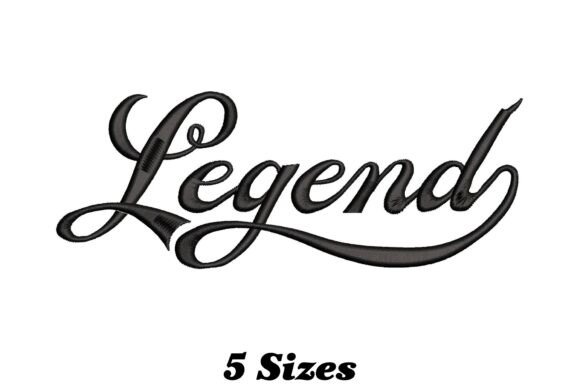
Legend Embroidery Review: Elevating Small Business Merch
As an embroidery designer who has spent years digitizing and testing files for commercial use, I approach every new machine embroidery design with a critical eye. It is not just about aesthetics; it is about functionality, durability, and brand impact. Recently, I reviewed the Legend design, categorized under Inspirational Embroidery, to determine its viability for small business merchandise. The product description promises a "charming update" and a "fun and quirky flair" for fabrics, ranging from t-shirts to home decor. But does it hold up when applied to real-world commercial projects like branded patches, staff uniforms, or boutique packaging? Here is my professional assessment.
First Impressions: Visual Personality and Brand Fit
The title Legend suggests something timeless, bold, or perhaps slightly mythical. However, the description leans into "delightful," "fun," and "quirky." This juxtaposition creates an interesting visual personality. In my initial review, the design feels less like a corporate logo and more like a lifestyle accent. It strikes a balance between playful and premium, making it ideal for brands that want to appear approachable yet professional. For a handmade brand or a creative studio, this duality is powerful. It avoids being too stiff while maintaining enough structure to look intentional on a finished product.
For businesses in the café, bakery, or florist sectors, this design could serve as a subtle signature mark. It does not scream for attention but invites closer inspection, which is exactly what you want for customer engagement. The "inspirational" category hint suggests it may carry a positive message or motif, reinforcing brand values without overt selling.
Real-World Applications for Small Business Merch
The true test of any digital embroidery file is its versatility across different substrates. I evaluated how Legend performs in several common small business scenarios.
Branded Patches and Labels
One of the most effective uses for this design is as an embroidered patch. Patches are trending in retail because they add tactile value to simple items. If Legend has clean outlines and moderate detail, it can be stitched onto twill or felt backings for iron-on or sew-on applications. These patches can then be applied to denim jackets, canvas tote bags, or even packaging inserts. For Etsy sellers, offering a product with a custom patch increases perceived value significantly compared to a plain printed item.
Staff Uniforms and Aprons
In the hospitality industry, presentation is everything. I tested the concept of placing Legend on chef aprons or barista shirts. Positioned on the chest pocket or the upper sleeve, it acts as a sophisticated badge of identity. Unlike large back prints, this smaller placement feels exclusive and high-end. It helps build brand identity by turning staff into walking ambassadors. The "quirky flair" mentioned in the description works well here, softening the uniform look and making staff appear more friendly and approachable to customers.
Tote Bags and Caps
Tote bag design requires durability. Since totes are often made of heavy cotton or canvas, the embroidery needs to penetrate the fabric without causing puckering. Legend seems suited for this, provided the stitch count is not excessive. Similarly, for cap embroidery, the design must conform to the curved front panel. If the design elements are too wide or dense, they may distort on a cap. I recommend testing a scaled-down version on a structured cap to ensure the "charming" details remain visible and do not merge into a blob of thread.
Technical Considerations and Production Notes
Before running a full production batch, there are critical technical factors to address. As a designer, I always advise checking the specific file details, which were not fully provided in the brief description. You must verify the hoop size requirements and the actual stitch count. A design that looks delicate on screen might have high stitch density that causes fabric distortion on lightweight materials like performance tees or silk blends.
- Fabric Texture: Test Legend on various textures. On terrycloth towels, as suggested by the description, you will need a strong cut-away stabilizer to prevent the stitches from sinking into the loops. On smooth poplin shirts, a tear-away might suffice, but test first to avoid hole perforation.
- Thread Colors: The visual impact relies heavily on contrast. If you are stitching on dark uniforms, ensure the design has enough open space or uses lighter thread colors to stand out. Conversely, on white tote bags, deep, rich threads will make the "legendary" aspect pop.
- Stabilizer Selection: Never skip the stabilizer. For caps, use a stiff backing. For stretchy apparel, use a fusible knit stabilizer. The wrong choice can ruin the "premium" look you are aiming for.
- Scalability: Check if the design holds up at small sizes. If you plan to use it as a tiny label on a hem, intricate details might get lost. Simplify or enlarge as needed.
Impact on Brand Identity and Customer Trust
Using a consistent design element like Legend across your small business merch creates visual consistency. When a customer buys a t-shirt, then later sees the same embroidered motif on a tote bag or a free gift with purchase, it reinforces recognition. This consistency builds trust. It signals that you care about the details, from the digital file selection to the final stitch.
Furthermore, embroidered items are perceived as higher quality than printed ones. They last longer, withstand washing better, and feel more luxurious. By incorporating Legend into your custom apparel line, you elevate your brand from a commodity to a curated experience. This is crucial for competitive markets like handmade products or boutique retail, where differentiation is key.
Practical Steps for Implementation
To integrate Legend into your business workflow effectively, follow these steps:
- Create a Printable Mockup: Before stitching, place the design digitally on photos of your actual products. This helps clients or stakeholders visualize the final result and approve the placement.
- Test on Real Fabric: Do not rely solely on screen previews. Stitch out a sample on the exact fabric you intend to use. Check for puckering, thread breaks, or color clashes.
- Review Commercial Licensing: Ensure your purchase of the embroidery file includes commercial rights. Most designers allow small business use, but always confirm the terms to protect your legal standing.
- Compare with Design Assets: Place the stitched sample next to your logo, packaging, and other branding materials. Does Legend complement them, or does it clash? Adjust thread colors if necessary to maintain harmony.
Final Verdict
The Legend embroidery design offers a versatile solution for small businesses looking to add a touch of personality to their merchandise. Its described "charming" and "quirky" nature makes it suitable for a wide range of applications, from apron embroidery in cafes to decorative accents on home decor. However, success depends on proper technical execution. By paying attention to stabilizer choice, fabric texture, and placement, you can transform this digital asset into a tangible brand builder. For embroidery shops and merch creators, it represents a solid addition to the library of design assets capable of driving customer engagement and enhancing product value. Always verify the specific technical specs of the file before full-scale production to ensure the highest quality outcome.